
The Cement Part 02
Cement materials can be classified into two distinct categories: non-hydraulic cement and hydraulic cement according to their respective setting and hardening mechanisms. Hydraulic cement setting and hardening involve hydration reactions and therefore require water, while non-hydraulic cement only reacts with gas and can directly be set under air.
Hydraulic cement

Clinker nodules are produced by sintering at 1450 °C.
By far the most common type of cement is hydraulic cement, which hardens by hydration of the clinker minerals when water is added. Hydraulic cement (such as Portland cement) is made of a mixture of silicates and oxides, the four main mineral phases of the clinker, abbreviated in the cement chemist notation, being:C3S: Alite (3CaO·SiO2);C2S: Belite (2CaO·SiO2);C3A: Tricalcium aluminate (3CaO·Al2O3) (historically, and still occasionally, called celite);C4AF: Brownmillerite (4CaO·Al2O3·Fe2O3).
The silicates are responsible for the cement's mechanical properties the tricalcium aluminate and brownmillerite are essential for the formation of the liquid phase during the sintering (firing) process of clinker at high temperature in the kiln. The chemistry of these reactions is not completely clear and is still the object of research.
First, the limestone (calcium carbonate) is burned to remove its carbon, producing lime (calcium oxide) in what is known as a calcination reaction. This single chemical reaction is a major emitter of global carbon dioxide emissions.

The lime reacts with silicon dioxide to produce di-calcium silicate and tricalcium silicate


The lime also reacts with aluminum oxide to form tricalcium aluminate.

In the last step, calcium oxide, aluminum oxide, and ferric oxide react together to form cement.

Non-hydraulic cement
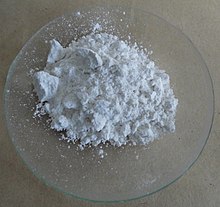
Calcium oxide is obtained by thermal decomposition of calcium carbonate at high temperatures (above 825 °C).
A less common form of cement is non-hydraulic cement, such as slaked lime (calcium oxide mixed with water), which hardens by carbonation in contact with carbon dioxide, which is present in the air (~ 412 vol. ppm ≃ 0.04 vol. %). First calcium oxide (lime) is produced from calcium carbonate (limestone or chalk) by calcination at temperatures above 825 °C (1,517 °F) for about 10 hours at atmospheric pressure:
The calcium oxide is then spent (slaked) by mixing it with water to make slaked lime (calcium hydroxide):

Once the excess water is completely evaporated (this process is technically called setting), the carbonation starts

This reaction is slow because the partial pressure of carbon dioxide in the air is low (~ 0.4 millibars). The carbonation reaction requires that the dry cement be exposed to air, so the slaked lime is a non-hydraulic cement and cannot be used underwater. This process is called the lime cycle.
part 01- introduction of cement
part 03-modern cement